


+86-13971665988 | info@justcaredisposable.com


Views: 0 Author: Site Editor Publish Time: 2026-08-29 Origin: Site


Subpar single-use items carry hidden operational costs that quietly drain salon profitability. A failing headband disrupts workflows, compromises client comfort, and damages salon credibility. When a band snaps mid-service or slips during a delicate procedure, the esthetician must stop, sanitize, and reapply. This breaks the client's relaxation and wastes valuable treatment time. Selecting the right Disposable Spa Headband acts as a primary operational safeguard.
Salons and estheticians balance strict state board sanitation protocols with overhead costs. They must ensure products do not interfere with high-stakes services like Hydrafacials, lash extensions, or chemical peels. A compromised hairline during an acid peel leads to chemical burns. A slipping band during lash mapping ruins adhesive placement. Salon owners need a systematic framework for evaluating supplies based on material science, tension reliability, and cost-to-failure ratios rather than just unit price.
Material Integrity Dictates Performance: Non-woven fabrics and soft, breathable polyesters prevent product absorption, heat buildup, and client skin irritation.
Tension is a Critical Metric: An optimal elastic spa treatment headband must accommodate diverse head circumferences without snapping, slipping, or causing tension headaches.
Sanitation Compliance is Non-Negotiable: Single-use verification and hygienic dispensing methods are required to prevent cross-contamination (avoiding the industry pitfall of reusing degraded supplies).
True Cost Includes Failure Rates: The cheapest bulk option often results in higher actual costs due to mid-treatment breakages, the need to double-band, and negative impacts on client experience.
The primary function of any hair management tool in a clinical setting is complete isolation. Isolating hair completely from active ingredients like trichloroacetic acid (TCA), essential oils, and hot waxes prevents severe treatment complications. If a headband shifts, baby hairs fall into the treatment zone. This creates a messy removal process for hard wax or risks chemical damage to the hair shaft during intensive exfoliation treatments.
Zero-slip performance remains an absolute necessity during 60-to-90-minute services. Treatments like microdermabrasion, dermaplaning, or lash mapping require intense precision. Stray hairs snag in mechanical equipment, dull surgical blades, or ruin sensitive cyanoacrylate adhesives used in lash extensions. A reliable band stays exactly where the esthetician places it, maintaining a secure barrier from the first double cleanse to the final application of SPF.
Consider the specific risks associated with poor hair management during advanced treatments:
Dermaplaning: A slipping band allows hair to fall into the path of the surgical blade, risking accidental cutting of the client's natural hairline.
Chemical Peels: Acid solutions tracking into unprotected hair can cause localized chemical burns on the scalp or permanent bleaching of dyed hair.
Lash Extensions: Bulky or shifting bands disrupt the esthetician's ergonomic hand placement on the client's forehead, leading to poor isolation and adhesive application.
Microneedling: Stray hairs entering the micro-wounds increase the risk of bacterial infection and granuloma formation.
Porous, reusable cloth headbands present a significant liability in modern spa environments. Cloth fibers easily harbor bacteria, dead skin cells, and residual product if not laundered with industrial-grade bleach and high heat. State board regulations mandate strict esthetician hygiene. Failing to properly sanitize reusable items results in heavy fines or facility closures. Reusable items degrade quickly under harsh washing protocols, losing their elasticity and softness after just a few cycles.
Specific dangers exist when reusing raggedy or compromised headbands across multiple clients. Items touching the face, ears, and hairline must be strictly single-use to guarantee zero cross-contamination. Using high-quality disposable spa headbands eliminates the risk of transferring acne-causing bacteria, demodex mites, or fungal infections between clients. It provides a clean, documented baseline for sanitation compliance that state inspectors look for during routine audits.
The tactile feel of your supplies directly influences the client's perception of your spa's overall quality and cleanliness. When a client lies down on the treatment bed, the first physical contact they experience is the application of the headband. If the material feels cheap, scratchy, or rough, it immediately sets a negative tone for the service. Premium materials signal that the clinic invests in client comfort at every level.
Clients immediately notice the difference between a soft, comfortable band and a scratchy, overly tight one. A band that applies too much pressure causes tension headaches, completely ruining the relaxation aspect of a facial or massage. Conversely, a well-fitted, soft band goes unnoticed by the client, allowing them to fully immerse themselves in the treatment. This directly impacts their relaxation, their likelihood to rebook, and their subsequent online reviews.
Continuous-loop elastic bands are the most common choice in fast-paced clinical environments. These bands feature a fully enclosed elastic cord wrapped in a non-woven or polyester casing. The primary advantage is rapid application. Estheticians hook the band on their thumbs, stretch it over the client's face, and secure the hair in seconds. This saves valuable minutes during room turnover. They offer a universal fit and a secure hold, making them highly convenient for standard facials and massage therapy.
Drawbacks appear when manufacturing quality drops. Poorly stitched internal elasticity snaps under pressure. Tension variance across different batches causes inconsistency; one box fits perfectly, while the next box contains bands that compress the skull. Sourcing a reliable elastic spa treatment headband from a vetted manufacturer mitigates these risks entirely, ensuring uniform stretch and durability across every single unit.
Adjustable non-woven bands with hook-and-loop fasteners offer a different approach to hair management. These bands wrap around the head and secure at the front or side. They are highly adjustable and avoid the need to pull a tight band over the client's face or fresh makeup. This makes them ideal for clients with mobility issues, elaborate hairstyles, or those who experience claustrophobia with continuous-loop bands.
The disadvantages center around the fastening mechanism itself. The hook side of the velcro easily snags on fine baby hair, causing client discomfort during removal. It also catches on expensive spa linens, microfiber towels, and the esthetician's uniform. Furthermore, these bands require a slightly slower application time compared to continuous-loop elastic options, as the esthetician must carefully align the closure tabs.
Full-coverage options like tie-back caps or bouffants are designed for maximum hair containment. These are heavily utilized for clients with exceptionally voluminous hair or during intensive chemical treatments where absolute protection of the entire scalp is necessary. They ensure that not a single strand of hair falls into the treatment zone.
The cons of full-coverage caps include the generation of excess heat. The greenhouse effect on the scalp makes the client sweat and feel uncomfortable during longer 90-minute sessions. They also require a longer application time and are generally less aesthetically pleasing for the client experience. Most clients prefer the minimalist feel of a standard headband over wearing a full surgical-style cap unless the specific treatment strictly demands it.
Headband Type | Primary Advantage | Primary Disadvantage | Best Use Case |
|---|---|---|---|
Continuous-Loop Elastic | Rapid application and secure hold | Can snap if poorly manufactured | Standard facials, lash extensions, fast turnovers |
Velcro-Closure | Highly adjustable, no face-pulling | Can snag hair and spa linens | Clients with elaborate hair or mobility issues |
Bouffant/Full Cap | Maximum hair containment | Generates excess heat, less comfortable | Intensive chemical peels, high-volume hair |
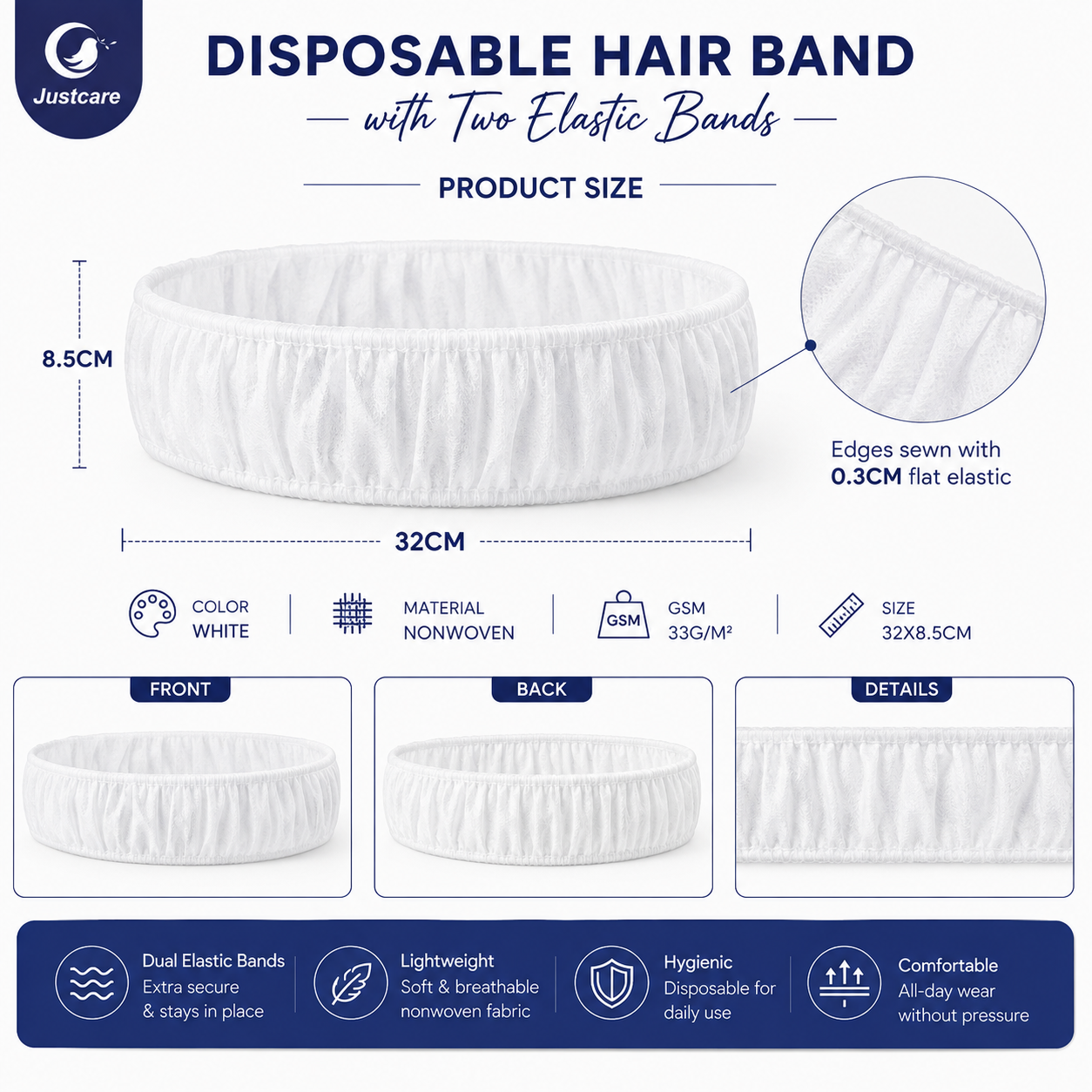
The foundation of a reliable headband lies in its material composition. Comparing non-woven polypropylene against soft, breathable polyester blends reveals distinct performance differences. Polypropylene is highly cost-effective and provides an excellent moisture barrier. Water beads up and rolls off the hydrophobic surface, protecting the hair during a thorough double cleanse. Polyester blends offer superior softness and stretch, closely mimicking the feel of traditional cloth without the sanitation risks.
Evaluate breathability, moisture resistance, and skin-friction coefficients to ensure maximum comfort. Moisture resistance prevents facial products, water, and chemical peels from seeping through the band and into the client's hair. Simultaneously, the material must have a low skin-friction coefficient. Rough materials create micro-tears or redness along the hairline, highly problematic for clients with sensitive skin or rosacea. Hypoallergenic, latex-free materials are mandatory to prevent allergic contact dermatitis.
Material Type | Moisture Resistance | Breathability | Skin Friction Level |
|---|---|---|---|
Non-Woven Polypropylene | High (Hydrophobic) | Moderate | Low to Moderate |
Polyester Blend | Moderate | High | Very Low (Soft) |
Cotton-Derived Biodegradable | Low (Absorbent) | High | Low |
A headband is only as good as its stretch. Define the ideal stretch parameters before purchasing. A professional-grade band comfortably accommodates circumferences ranging from 12 to 25 inches. If the maximum stretch is too low, the band compresses the client's skull. If the rebound elasticity is weak, the band sags and slips down the forehead as soon as it is applied. The band needs to clear the nose and chin during application without dragging across the skin.
The construction of the elastic casing is just as important as the elastic itself. The casing must be securely stitched to prevent the internal rubber or synthetic polymer from snapping under pressure. A well-constructed casing distributes the tension evenly across the band. This ensures the band does not leave deep, red indentation marks on the client's forehead, which take hours to fade and ruin the post-facial glow.
Band width directly impacts both hair containment and the available treatment area. Evaluating how band width impacts performance prevents operational headaches. A narrow 2-inch band struggles to hold back thick hair or secure short baby hairs at the nape of the neck. Conversely, a wide 4-inch band provides excellent containment but encroaches on the upper forehead, limiting the esthetician's access during dermaplaning or chemical exfoliation.
The optimal width typically falls between 2.5 and 3 inches. This dimension secures baby hair effectively and provides comfort around the ears without covering vital facial real estate. It allows the practitioner to treat right up to the hairline, ensuring an even application of masks, peels, and serums without getting product stuck in the fabric.
Procurement managers face the logistical trade-off of buying large cases to lower unit costs versus managing the physical storage space required in a clinical setting. Ordering massive quantities drops the per-item cost significantly, but storing large corrugated boxes in a small boutique spa creates operational friction. Cluttered backrooms lead to inventory mismanagement and make it difficult for staff to locate necessary items quickly.
Discuss optimal pack sizes based on your facility's volume. Solo estheticians benefit from 30-to-50 unit packs that fit neatly into a trolley drawer or a small cabinet. Large medspas with multiple treatment rooms handle bulk cases easily, provided they have dedicated, climate-controlled storage areas. Maintaining inventory efficiency without cluttering treatment rooms ensures that disposable beauty supplies remain clean, accessible, and organized.
Evaluating supplies solely on baseline unit price is a flawed procurement strategy. Use a framework for calculating actual operational cost: Unit Price + (Failure Rate % × Time Lost) + Client Dissatisfaction. If a band snaps 10% of the time, the actual cost includes the esthetician's lost time, the disruption of the service, and the potential loss of a returning client. Time is the most expensive commodity in a salon.
Avoid ultra-cheap options that require using two bands simultaneously to achieve adequate tension. Double-banding defeats the purpose of buying a cheaper product, as you instantly double your inventory burn rate. It looks unprofessional and feels bulky on the client's head. Investing slightly more in a high-tensile, reliable band reduces failure rates to near zero, ultimately saving money and preserving the clinic's reputation.
The tension between single-use plastics and eco-conscious salon initiatives is a growing concern in the beauty industry. Salons want to reduce their carbon footprint, but state health boards mandate strict sanitation protocols that heavily favor single-use synthetics. Non-woven polypropylene and polyester are petroleum-based and typically end up in landfills, creating a conflict for green-certified spas.
Evaluate emerging biodegradable or recyclable disposable options. Cotton-based or bamboo-derived non-wovens are entering the market. Assess their current performance limitations regarding stretch and moisture resistance. Many biodegradable options currently lack the tensile strength of synthetics or absorb too much liquid, allowing facial products to seep into the hair. Until eco-friendly options match the performance of standard synthetics, clinics prioritize sanitation and client safety while seeking specialized recycling programs for traditional materials.
How you store and dispense your supplies is just as important as what you buy. The primary risk is open-air bulk storage. Leaving a large, open bag of headbands on a counter leads to pre-use contamination from airborne spa particles. Hairspray from styling stations, acrylic dust from nail tech areas, and aerosolized disinfectants easily settle on unprotected fabrics. Applying a contaminated band to a client's freshly cleansed face defeats the purpose of using a single-use item.
Mitigate this risk by implementing closed, touchless acrylic dispensers in every treatment room. Alternatively, source individually wrapped bands for high-risk clinical environments. Individually wrapped units guarantee absolute sterility upon opening, highly reassuring for clients undergoing invasive treatments like microneedling or deep chemical peels. Proper storage ensures the integrity of the product from the warehouse to the treatment bed.
Even the highest quality headband fails if applied incorrectly. The risk here is inconsistent application leading to client discomfort, slipped bands, or compromised treatment areas. If an esthetician drags a tight band roughly across a client's face, it smears makeup, pulls on eyelash extensions, or painfully snags earrings and piercings.
Mitigate this by developing Standard Operating Procedures (SOPs) for stretching and placing the band. Train staff to pre-stretch the elastic slightly before approaching the client. Expand the band fully, pass it over the face without making contact, and gently settle it over the ears and down to the nape of the neck. Standardizing this simple movement ensures a uniform, comfortable experience for every client, regardless of which practitioner they see.
A disposable spa headband operates as a primary clinical tool, not just a generic commodity. It protects the client, secures the treatment area, and ensures compliance with strict sanitation laws. Material softness, tensile strength, and client comfort dictate the purchasing decision over baseline price. Prioritizing performance eliminates the hidden costs of mid-treatment breakages and workflow disruptions.
Audit your current failure rates by tracking how many bands snap or slip during a single week of services.
Order small-batch samples from reputable suppliers to test material softness, moisture resistance, and stretch limits on staff members.
Implement touchless acrylic dispensers in every treatment room to protect your inventory from airborne contaminants.
Establish a standard operating procedure for applying the band to prevent makeup smudging and client discomfort during room turnover.
A: Single-use bands eliminate laundry overhead, including the costs of water, electricity, and industrial detergents. They guarantee absolute sanitation for every client, completely preventing cross-contamination from residual spa products, bacteria, or skin cells that often survive standard washing cycles in reusable cloth bands.
A: High-stakes services like Hydrafacials, chemical peels, lash extensions, and microdermabrasion require them most. In these treatments, stray hair interference compromises expensive mechanical equipment, ruins delicate adhesive bonds, or causes severe skin irritation if hair drags active acids across the face.
A: The industry standard width typically ranges from 2.5 to 3 inches. This dimension securely holds back fine baby hairs and thick locks without covering the forehead, ensuring the esthetician has full access to the entire facial treatment area.
A: Most standard options are made from non-woven polypropylene or polyester, which are petroleum-based and typically bound for landfills. The market is evolving, and biodegradable cotton-based or bamboo-derived alternatives are becoming available, though they currently have limitations in stretch and moisture resistance.
A: Cheap synthetic materials cause friction redness and discomfort. High-quality, latex-free, and hypoallergenic non-woven materials are specifically designed to mitigate irritation. Ensure your supplier uses medical-grade, skin-safe fabrics to protect clients with sensitive skin or conditions like rosacea.
A: Prevent slipping by selecting a band with high-rebound elasticity. Apply it correctly by stretching it fully over the face, securing it gently over the tops of the ears, and pulling the back down securely to the nape of the neck to anchor it against the skull's natural curve.
A: While most are marketed as universal, actual sizing varies by manufacturer. Buyers verify the maximum stretch circumference—ideally accommodating 25 inches or more—to ensure the band fits all clients comfortably without causing painful tension headaches during longer treatments.
