


+86-13971665988 | info@justcaredisposable.com


Views: 0 Author: Site Editor Publish Time: 2026-09-30 Origin: Site


Effective contamination control in critical environments depends fundamentally on the physical and chemical properties of the wiping materials utilized. Selecting an incompatible wipe material leads directly to particulate shedding, ionic contamination, or chemical degradation. These failures result in compromised yields, failed regulatory audits, and costly production downtime. Facility managers cannot rely on guesswork when outfitting a controlled environment. Evaluating Cleanroom Wipes requires a rigorous analysis of base substrates, construction methods, and edge-sealing technologies. You must ensure absolute alignment with specific ISO classifications, industry regulations, and distinct process requirements. A wipe designed for an ISO 7 gowning room will catastrophically fail inside an ISO 3 semiconductor core. We will break down the exact material specifications, chemical compatibilities, and structural mechanics you need to evaluate before approving any wiping product for your cleanroom floor.
Material composition (e.g., monofilament polyester, cellulose, microfiber) directly dictates a wipe’s absorbency, chemical compatibility, and baseline particle generation.
Construction methods (knit vs. nonwoven) and edge sealing (laser vs. ultrasonic) are just as critical as the base material for qualifying as low lint cleanroom wipes.
Cellulose polyester cleanroom wipes offer high absorbency and cost-efficiency for less critical zones (ISO 6-9), while 100% continuous filament knit polyester is mandatory for critical environments (ISO 3-5).
Procurement decisions must balance unit cost against the hidden costs of contamination risks, requiring validation through Technical Data Sheets (TDS) and in-situ testing.
Selecting the right wiping material requires a clear understanding of what constitutes success in a controlled environment. You cannot evaluate a material without first defining the specific contamination thresholds and mechanical demands of your facility. Wiping is a physical intervention. Every time an operator touches a surface, they introduce a variable. The goal is to ensure the wiping material removes existing contaminants without leaving new ones behind.
Establishing acceptable limits for contamination is the first step in material selection. ISO 14644-1 standards dictate the allowable particulate concentration per cubic meter of air, but surface contamination requires different metrics. Wiping materials introduce their own contamination variables that you must measure and control.
You must evaluate non-volatile residues (NVR). NVRs are soluble contaminants left behind on a surface after a solvent evaporates. Manufacturers measure NVRs using gravimetric analysis, typically reporting the results in milligrams per gram (mg/g) of wipe material. High NVR levels leave microscopic films on optical lenses or silicon wafers, ruining the product.
Ionic contamination represents another severe threat. Trace metals and ions, such as sodium, chloride, potassium, and calcium, can cause catastrophic electrical shorts in microelectronics or alter chemical reactions in pharmaceutical compounding. Laboratories detect these ions using ion chromatography. Viable particulates (bacteria, fungi) and non-viable particulates (fibers, dust) must remain below strict thresholds to prevent product adulteration. You must demand Technical Data Sheets (TDS) that explicitly list these baseline metrics for any wipe you consider.
Wiping materials rarely operate in isolation. They act as delivery vehicles for solvents and disinfectants. The necessity of matching wipe materials with common cleanroom solvents is absolute. When exposed to 70% isopropyl alcohol (IPA), acetone, methyl ethyl ketone (MEK), or sodium hypochlorite (bleach), the wipe must maintain structural integrity.
Incompatible materials suffer chemical degradation. For example, aggressive solvents like acetone can dissolve the chemical binders used in cheap nonwoven wipes. This extraction process pulls the adhesive out of the wipe and deposits it directly onto your critical surfaces, leaving invisible, damaging residues. In extreme cases, incompatible materials interacting with strong acids or oxidizers can trigger dangerous exothermic reactions. You must cross-reference the chemical resistance profile of the wipe's base polymer with your facility's approved solvent list.
The physical action of wiping places stress on the material substrate. Assessing the required abrasion resistance ensures the wipe will not tear, pill, or shed fibers when dragged across rough surfaces, textured stainless steel, or sharp equipment edges. A wipe that performs perfectly on smooth borosilicate glass might shred instantly on a perforated worktable.
Sorbency capacity dictates how much liquid the wipe can hold and how quickly it absorbs it. Heavy spill control requires high-capacity nonwovens that can rapidly pull large volumes of liquid away from sensitive equipment. Delicate optical cleaning demands soft, non-abrasive materials that trap microscopic particles without scratching sensitive anti-reflective coatings. You must match the mechanical strength of the wipe to the physical reality of the task.
The base substrate dictates the foundational properties of the wipe. Manufacturers engineer different fibers to solve specific contamination and operational challenges. Understanding the polymer science behind these materials prevents costly procurement errors.
Polyester is a synthetic, petroleum-based fiber characterized by high tensile strength and extreme chemical resistance. In critical environments, manufacturers use continuous filament extrusion. This monofilament construction prevents the fracturing common in short-staple fibers. Because the fiber is one continuous strand, it cannot easily break apart and shed particles into the environment.
This material produces the lowest possible particulate generation. It stands as the absolute standard for semiconductor manufacturing, microelectronics, and sterile pharmaceutical compounding. To achieve ISO 3 or ISO 4 compliance, manufacturers launder these wipes in 18-megohm ultra-pure Deionized (DI) water to strip away residual manufacturing oils and loose particles.
However, polyester is hydrophobic by nature. It naturally repels water. To make it useful for wiping, manufacturers apply specific surface treatments or utilize specialized double-knit interlock structures. These knit patterns create microscopic voids that draw liquids into the fabric through capillary action, achieving adequate liquid retention without compromising the synthetic strength of the fiber.
Facilities looking for a balance of performance and economy often turn to cellulose polyester cleanroom wipes. This material features a hydroentangled nonwoven blend, typically containing 55% cellulose and 45% polyester. It combines the high sorbency of natural wood pulp fibers with the structural strength of synthetic polyester.
The manufacturing process is vital here. Premium blends use spunlace hydroentanglement. This process uses high-pressure water jets to physically interlock the cellulose and polyester fibers, completely eliminating the need for chemical binders or adhesives. This mechanical bonding prevents the binder extraction risks associated with cheaper industrial rags.
These blends deliver exceptional sorbency and wiping efficiency. They are highly cost-effective for general surface cleaning, spill control, and routine equipment wipe-downs in pharmacy anterooms or gowning areas. The primary limitation is their baseline linting profile. Because cellulose consists of short natural fibers, these wipes exhibit higher particulate shedding compared to pure synthetic options. Consequently, quality control protocols generally restrict their use to ISO Class 6 (Class 1000) or higher environments.
Microfiber utilizes ultra-fine synthetic yarns, typically a blend of polyester and nylon (often in an 80/20 or 70/30 ratio). Manufacturers split these fibers during production to create a massive surface area with microscopic crevices. A cross-section of a split microfiber looks like a pie cut into wedges. Microfiber is available in both knit and nonwoven constructions, depending on the required durability and cleanliness.
The performance outcomes of microfiber are exceptional. The split fibers provide superior mechanical removal of sub-micron particles, microbes, and oily residues. They trap contaminants deep within the fiber matrix rather than just pushing them across the surface. This mechanical cleaning action reduces the reliance on heavy chemical solvents. This makes microfiber ideal for sensitive optics, precision lenses, and critical metallic surfaces.
The main limitation is the higher unit cost. Additionally, nonwoven microfiber is only suitable for ISO 6+ areas, while knit microfiber is appropriate for ISO 3-5. Operators must also handle knit microfiber carefully, as the fine loops can snag on rough surfaces, pulling the knit apart and generating unwanted particles.
Polypropylene is a highly durable synthetic polymer. It is exceptionally resistant to strong acids and bases, making it a staple in chemical processing areas. Manufacturers frequently use meltblown polypropylene nonwovens for heavy solvent absorption and industrial grease removal. Polypropylene is oleophilic (oil-attracting) and hydrophobic (water-repelling), making it perfect for wiping down machinery coated in synthetic lubricants.
Conversely, 100% woven cotton serves very niche applications. Facilities use cotton primarily for its high heat resistance. It is necessary for high-temperature equipment maintenance where synthetic fibers would melt onto the machinery. However, cotton sheds massive amounts of particulates. Cleanroom managers heavily restrict its use, allowing it only in specific, isolated maintenance procedures where heat resistance overrides particulate control.
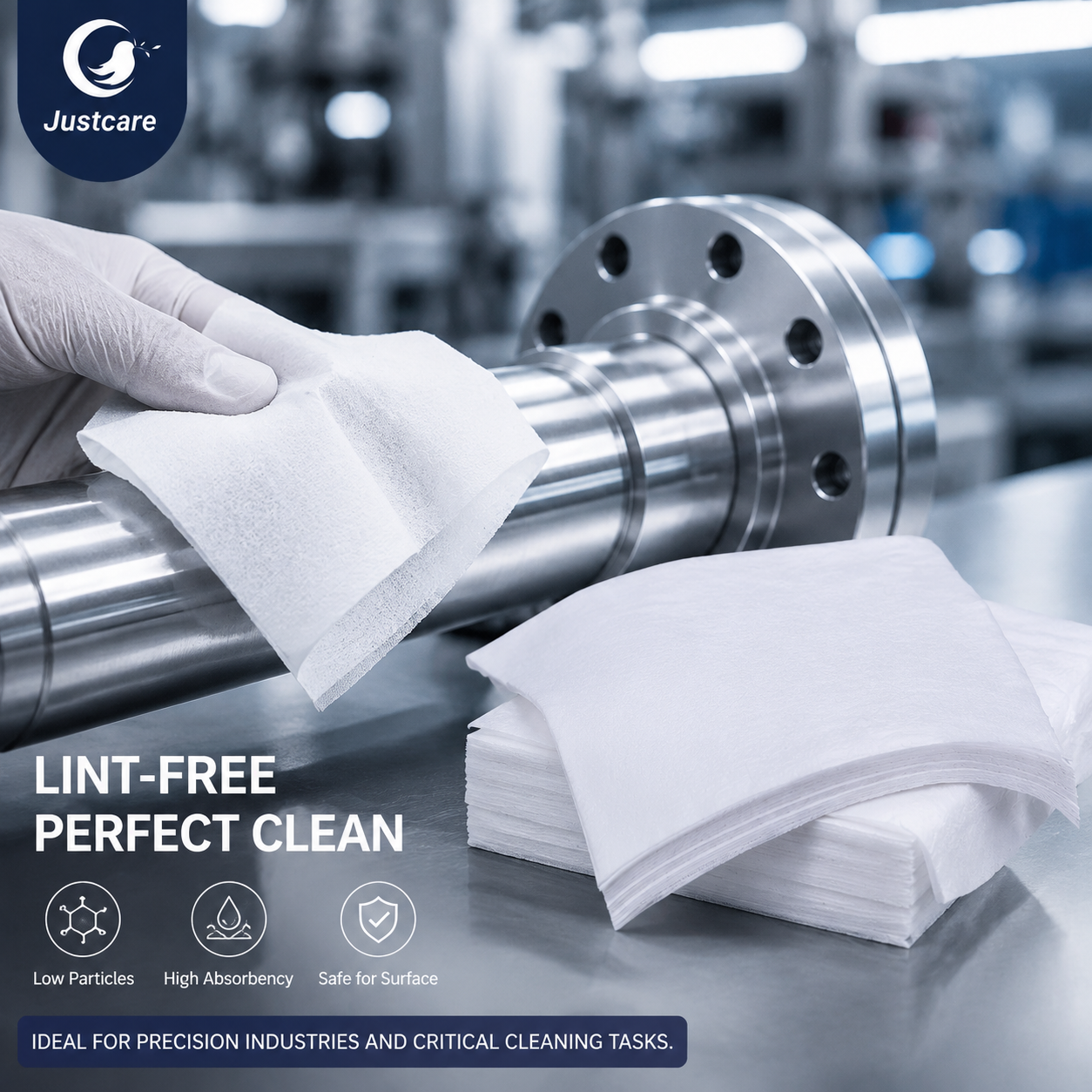
The base material is only half the equation. The way manufacturers construct the fabric and seal the edges determines whether the product functions effectively as low lint cleanroom wipes. Poor construction negates the benefits of high-quality fibers, turning an expensive polymer into a contamination hazard.
Knit wipes consist of interlocking loops of continuous yarn. The most common structure for critical environments is the double-knit no-run interlock. This mechanical structure provides immense structural integrity. It prevents fiber shedding by locking the continuous filaments together. If a single yarn breaks, the no-run knit prevents the entire fabric from unraveling. The knit structure also creates small pockets that trap particles effectively during the wiping process. Knit construction is absolutely essential for ISO 3-5 environments where particulate limits are near zero.
Nonwoven wipes consist of fibers bonded together mechanically, thermally, or chemically. They offer high absorbency and lower production costs. However, the lack of interlocking loops presents a higher risk of fiber shedding, especially under abrasive stress. Nonwovens serve best in less critical zones where liquid absorption outweighs absolute particulate control.
When manufacturers cut large rolls of fabric into individual wipes, the cutting process exposes loose fibers at the perimeter. How they manage these edges defines the wipe's cleanliness. An unsealed edge on a synthetic wipe will shed thousands of particles with every motion.
Edge Seal Type | Manufacturing Process | Particle Generation Risk | Edge Softness | Best Application |
|---|---|---|---|---|
Knife Cut (Cold Cut) | Physical blade slices the fabric, leaving raw edges. | High | Very Soft | ISO 7-9, General Spill Control |
Laser Sealed | High-powered laser cuts and melts the synthetic polymer into a solid bead. | Very Low | Rigid / Abrasive | ISO 3-5, Semiconductor, Flat Surfaces |
Ultrasonic Sealed | High-frequency vibration and pressure fuse the edge without a hard bead. | Ultra Low | Soft | ISO 3-5, Sensitive Optics, Medical Devices |
Knife-cut edges remain unsealed. This presents the highest risk of particle generation from the wipe's perimeter. Knife-cut edges are acceptable only in lower-grade cleanrooms or when using nonwoven cellulose blends where melting is impossible.
Laser sealing melts the loose fibers into a solid bead. It is the standard for critical environments. However, the melted polymer can create a slightly rigid, abrasive border that may scratch sensitive optics if the operator applies too much pressure.
Ultrasonic sealing uses high-frequency vibration to cut and seal the edge. It creates a soft, highly secure border without the hard polymer bead of a laser seal. Ultrasonic sealing is optimal for preventing micro-scratches on sensitive equipment while maintaining strict particulate control.
Matching the wipe material to the specific ISO classification of your facility prevents both contamination failures and unnecessary overspending. Regulatory requirements dictate specific material profiles for different cleanroom grades. You must map your procurement strategy directly to your environmental monitoring limits.
These ultra-clean environments tolerate zero margin for error. Mandatory specifications require 100% continuous filament knit polyester or premium knit microfiber. Nonwoven materials are strictly prohibited due to fiber shedding risks. The mechanical stress of wiping in these zones must not generate any measurable particulate fallout.
Processing requirements for these wipes are intense. Manufacturers must launder them in ultra-pure DI water to remove residual manufacturing oils and loose particles. They must package the final product in an ISO 4 environment using double-bagging protocols. Laser or ultrasonic sealed edges are non-negotiable. For aseptic environments, such as pharmaceutical compounding or biologics manufacturing, the wipes often require validated gamma irradiation to ensure absolute sterility, accompanied by a Certificate of Irradiation (CoI).
These environments allow for more flexible material choices. Acceptable specifications include nonwoven cellulose polyester blends or nonwoven polypropylene. The focus in these zones shifts toward sorbency and economical surface coverage rather than absolute zero-particulate thresholds.
Processing requirements are less stringent. Knife-cut edges are generally acceptable. Facilities use these wipes for heavy cleaning, spill response, and equipment preparation before moving items through material airlocks into cleaner zones.
Different industries prioritize different contamination metrics based on their final product. A wipe that passes a pharmaceutical audit might fail a microelectronics audit.
Semiconductor & Microelectronics: This sector prioritizes ultra-low NVRs and ion levels. A single sodium ion can destroy a microchip architecture. These facilities rely heavily on laundered, ultrasonically sealed continuous polyester wipes to prevent both particulate and chemical contamination.
Pharmaceutical & Biologics: This sector prioritizes sterility, endotoxin limits, and chemical compatibility. Operators use aggressive disinfectants like sporicides and bleach. These facilities rely heavily on gamma-irradiated polyester and pre-wetted formats to ensure consistent sanitization without material degradation.
Medical Device Assembly: This sector requires a balance of particulate control and mechanical strength to wipe down stainless steel components and extruded plastics without leaving fibers behind.
Procurement teams often face pressure to reduce consumable spending. However, evaluating industrial PPE supplies requires looking past the initial invoice. Material selection directly impacts operational efficiency and risk mitigation. Buying the cheapest wipe often results in the most expensive production failures.
Analyzing procurement strictly by unit cost is dangerous. Substituting cheaper nonwoven wipes in critical zones leads to exponential costs in yield loss and failed regulatory audits. A knit polyester wipe may cost three times as much as a cellulose blend. However, if the cellulose blend sheds fibers onto a silicon wafer, the resulting scrap cost eclipses the savings generated by the cheaper wipe. You must evaluate the cost of the wipe against the value of the product it touches.
Facilities must choose between dry wipes paired with bulk solvents or pre-saturated wipes. Dry wipes present a lower initial cost. However, pre-wetted wipes offer significant operational benefits. They guarantee consistent solvent application, ensuring every surface receives the exact concentration of disinfectant required by the Standard Operating Procedure (SOP). They reduce Volatile Organic Compound (VOC) emissions by eliminating open solvent bottles on the cleanroom floor. They also enable faster protocol execution, saving valuable operator labor time and reducing the risk of solvent cross-contamination.
Standardizing a single wipe material across an entire facility seems efficient but creates financial bloat. Using premium laundered polyester in an ISO 8 gowning room wastes budget. Conversely, using a nonwoven blend in an ISO 4 core zone invites contamination. A tiered approach optimizes the procurement budget. Assign premium knit wipes for core zones and economical cellulose blends for gowning and prep areas. This requires managing multiple SKUs but drastically reduces overall consumable spending.
Evaluating manufacturers goes beyond the product spec sheet. You must assess lot-to-lot consistency. A reliable manufacturer provides transparent Technical Data Sheets (TDS) detailing NVRs, ion counts, and particulate generation for every batch. Raw material sourcing reliability ensures that your chosen wipe remains available and consistent over years of production. Changing wipe materials requires extensive re-validation, so selecting a stable manufacturing partner is paramount.
Even the highest-grade materials fail if operators deploy them incorrectly. Material performance relies entirely on proper execution and rigorous validation. You cannot buy your way out of bad wiping technique.
Poor technique negates the benefits of high-grade materials. Circular wiping or aggressive scrubbing simply moves contaminants around and re-deposits them onto the surface. Operators must utilize the quarter-folding technique to maximize the utility of the wipe and trap particles effectively.
Hold the wipe flat by the edges to avoid transferring oils from gloves to the center of the fabric.
Fold the wipe in half evenly.
Fold the wipe in half again, creating a square with eight distinct clean faces.
Apply the approved solvent directly to the wipe, not the surface, to prevent aerosolizing contaminants.
Wipe the surface in straight, overlapping linear strokes, pulling contaminants in one direction.
Flip to a clean face of the folded wipe after every stroke to prevent cross-contamination.
Using aggressive solvents on incompatible nonwoven materials presents a severe invisible risk. Solvents can extract chemical binders or short fibers from the wipe. This leaves a film of non-volatile residues on critical surfaces. You must mitigate this risk by verifying the chemical compatibility of the specific substrate against your facility's exact solvent concentrations. Never assume a wipe is universally compatible with all industrial chemicals.
Never finalize procurement contracts based solely on marketing claims. You must conduct in-house trials and validation testing. The Helmke Drum test (IEST-RP-CC004.3) measures the number of particles shed by a dry wipe under mechanical stress by tumbling it in a rotating drum and measuring the air with a particle counter. Liquid Particle Counts (LPC) assess the cleanliness of the wipe when saturated, using a biaxial shaker to release particles into a fluid bath. Conducting these tests ensures the material performs as expected within your specific operational parameters.
Audit your current cleanroom zones and map the exact ISO classification to the wiping materials currently in use to identify compliance gaps.
Request updated Technical Data Sheets (TDS) from your suppliers to verify non-volatile residue (NVR) and ionic contamination baselines.
Implement a tiered procurement strategy, assigning continuous filament polyester to ISO 3-5 zones and cellulose blends to ISO 6-9 zones.
Standardize the quarter-fold wiping technique across all shifts through mandatory hands-on operator training.
Conduct Helmke Drum and Liquid Particle Count validation testing on any new wipe substrate before authorizing it for use on critical surfaces.
A: A suitable wipe must generate exceptionally low levels of particulates, non-volatile residues (NVRs), and ions. It must resist chemical degradation from common solvents like IPA and feature specific construction methods, such as continuous filament knitting and sealed edges, to prevent fiber shedding during use.
A: They are low lint compared to standard industrial rags, but they shed more particles than 100% knit synthetic wipes. Because they contain natural short-staple cellulose fibers, they are generally restricted to ISO Class 6 through 9 environments where absolute zero-particulate thresholds are not required.
A: Woven wipes interlace yarns in a grid, often shedding at the cut edges. Knit wipes interlock continuous loops of yarn, providing high strength and trapping particles effectively without shedding. Nonwoven wipes bond fibers together mechanically or chemically, offering high absorbency but posing a higher risk of fiber release under stress.
A: No. Standard industrial supplies lack the strict particulate and chemical controls required for cleanrooms. They are not laundered in DI water, lack sealed edges, and often contain binders or natural fibers that introduce massive amounts of contamination into controlled environments.
A: Cutting synthetic fabric leaves loose, broken fibers at the perimeter. Edge sealing technologies, such as laser melting or ultrasonic vibration, fuse these loose fibers together. This prevents the wipe from shedding particles from its edges when subjected to the mechanical stress of wiping.
