


+86-13971665988 | info@justcaredisposable.com


Views: 0 Author: Site Editor Publish Time: 2026-08-31 Origin: Site


Side leakage in incontinence management rarely happens because a product reaches its absolute maximum fluid capacity. Instead, leaks occur due to a mechanical mismatch. Fluid velocity outpaces the core absorption rate. Poor anatomical fit creates gaps at the leg. Structural barriers fail under physical pressure. Understanding this dynamic solves a daily problem for care facilities and home caregivers. Chronic side leakage takes a severe physical and emotional toll. It disrupts sleep cycles. It causes rapid caregiver burnout from daily bedding changes. Trapped moisture significantly increases the risk of severe skin breakdown and dermatitis. Selecting the right product requires a technical evaluation framework. We must examine the specific material components designed to contain sudden voids. We will analyze how advanced cores neutralize odors and lock in moisture. By understanding these mechanics, you can choose Adult Diapers that provide reliable overnight protection.
Fit Over Capacity: Sizing up is a primary cause of side leaks; a secure seal at the leg gathers is more critical than maximum total absorbency.
Structural Barriers are Mandatory: Effective leak proof incontinence diapers must feature tall, hydrophobic inner leg cuffs (leak guards) to create a physical containment reservoir.
Absorption Velocity Matters: High absorbency adult diapers must utilize advanced fluid distribution channels to move liquid away from the edges faster than it is expelled.
Application Errors Compromise Tech: Common practices, such as using petroleum-based barrier creams without proper liners, actively repel liquid and cause immediate side leakage.
Many caregivers misunderstand how incontinence products are rated by manufacturers. A diaper's maximum volume rating simply measures total fluid held under static laboratory conditions. It does not account for real-world application or the physics of a human void. Absorption rate is an entirely different metric. It measures how fast the core can pull liquid away from the surface topsheet and into the storage layers. This distinction dictates success or failure in managing heavy incontinence.
Sudden, high-velocity voids easily overwhelm slow-absorbing cores. A typical adult bladder can expel 200ml of fluid in under ten seconds. If the diaper's topsheet only processes 10ml per second, 100ml of fluid pools on the surface immediately. Fluid always seeks the path of least resistance. Gravity and body movement push this pooled urine outward toward the leg openings. High total capacity means nothing if the absorption velocity is too slow to catch the initial surge.
Performance Metric | Definition | Impact on Side Leakage |
|---|---|---|
Total Capacity (ISO Rating) | Maximum fluid volume the product holds before total saturation. | Low impact on sudden leaks. Only matters for extended wear times. |
Absorption Velocity | Speed at which fluid penetrates the topsheet and enters the core. | High impact. Slow velocity causes surface pooling and immediate lateral runoff. |
Rewet Rate (Press-Out) | Amount of fluid that returns to the surface under physical pressure. | High impact. Poor rewet rates cause fluid to squeeze out when the user sits. |
Body positioning drastically alters how fluid interacts with an absorbent core. A person standing up directs fluid downward into the center of the diaper, utilizing the thickest part of the padding. Sitting for extended periods shifts the pooling area toward the rear buttocks. Side-sleeping creates the highest risk for leakage. In a lateral recumbent position, gravity pulls the fluid directly against the side leg gathers. The product must manage these shifting dynamics flawlessly without sagging.
Effective elder care hygiene supplies require a continuous, unbroken seal against the skin. The diaper must maintain structural integrity during patient repositioning. When a bedbound individual is turned every two hours to prevent bedsores, the diaper shifts with the body. If the leg elastics gap during these movements, fluid escapes instantly. A successful product adapts to posture changes while maintaining a tight physical barrier against the inner thigh.
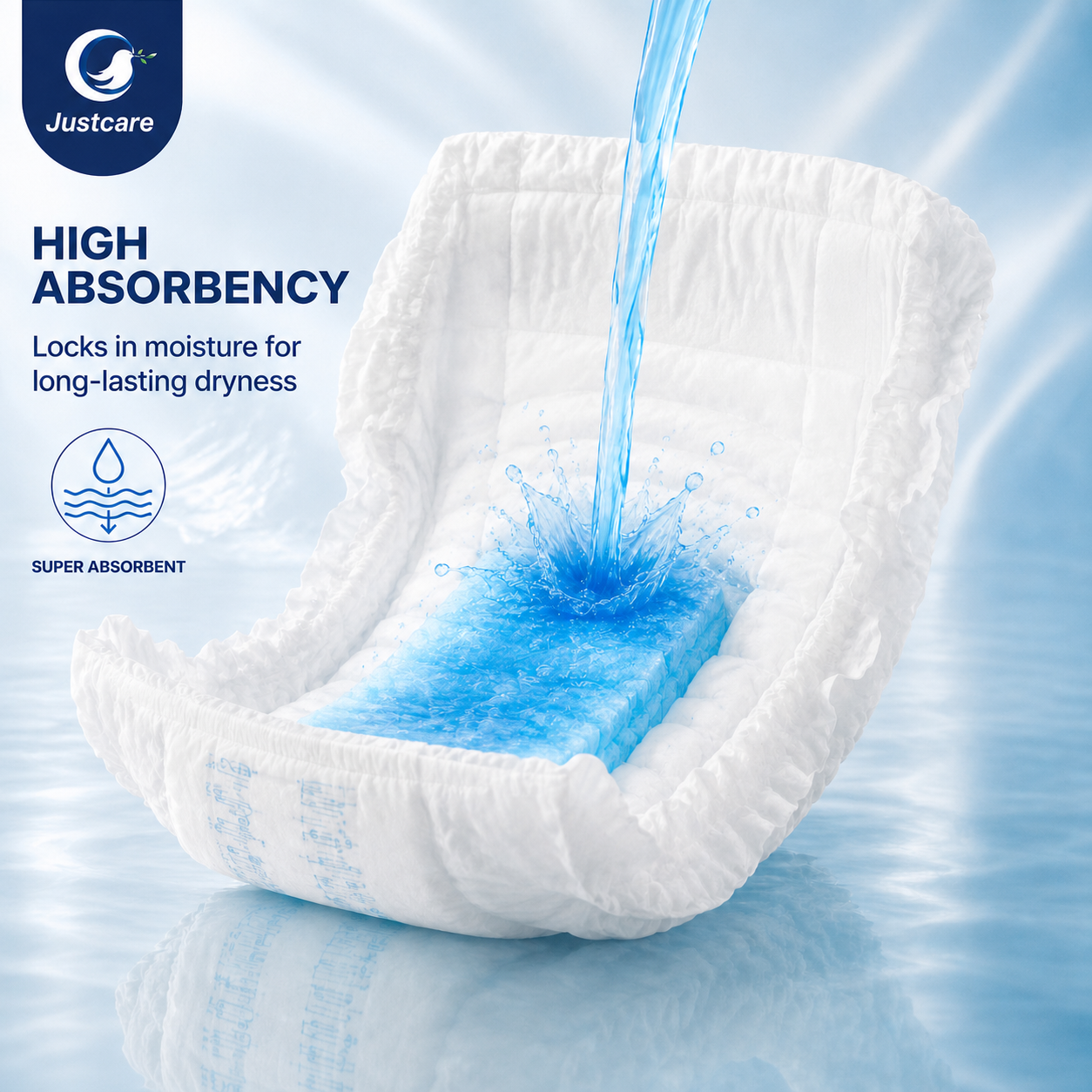
The technical makeup of the absorbent core dictates performance under physical pressure. Older or lower-quality diapers rely heavily on wood pulp fluff. Fluff absorbs liquid like a standard household sponge. However, like a sponge, it releases that liquid when squeezed. When a 150-pound user sits in a wheelchair or rolls over in bed, body weight compresses the fluff. This forces the trapped urine back to the surface and out the sides.
Modern cores utilize Superabsorbent Polymers (SAP), typically made from sodium polyacrylate. These tiny synthetic beads absorb up to 300 times their weight in water. More importantly, SAP locks moisture into a solid, dry gel. High SAP-to-fluff ratios are absolutely necessary for heavy incontinence management. The resulting gel cannot be squeezed out under body weight. This prevents the dreaded "press-out" leakage. Furthermore, advanced SAP chemically neutralizes ammonia. This provides odor control that is instantly lost the moment a side leak breaches the leg seal.
Premium high absorbency adult diapers feature multi-layered construction to manage fluid dynamics. The most critical component is the Acquisition and Distribution Layer (ADL). This porous synthetic sub-layer sits directly beneath the topsheet. It serves as a rapid transit system for fluid. Without an ADL, liquid pools in one concentrated spot, saturating a small area of SAP while leaving the rest of the diaper dry.
The ADL rapidly wicks moisture away from the initial point of insult using capillary action. It then disperses the fluid longitudinally across the entire length of the core. This action keeps liquid away from the vulnerable side margins. By utilizing the full surface area of the SAP, the ADL maximizes the diaper's efficiency. It ensures the edges remain dry, drastically reducing the chance of lateral runoff during a heavy void.
Core placement plays a massive role in leak prevention. Standard unisex designs distribute SAP evenly from front to back. This approach often fails to address specific anatomical needs. Men and women pool fluid in different areas based on anatomy and sleeping positions. Generic cores often leave critical zones under-protected, leading to predictable failure points.
Gender-specific or targeted cores offer superior protection by placing the absorption material exactly where it is needed. Male-focused designs feature front-heavy absorbency zones. This catches upward and forward fluid trajectories, especially for stomach sleepers. Female-focused designs concentrate SAP in the center and lower rear. This manages downward flow and pooling while seated. Matching the core's zonal absorbency to the user's specific anatomy is a highly effective strategy for stopping leaks.
Inner leg cuffs are the most critical anti-leak feature on any incontinence product. These are not the outer frills visible on the edge of the diaper. Leak guards are internal fabric strips that stand up vertically against the groin crease. They form a physical wall against sudden, high-volume voids. Without them, liquid simply rolls off the topsheet and down the leg before the core has a chance to absorb it.
These guards are constructed from highly hydrophobic spunbond polypropylene. They actively repel water. When a sudden void occurs, the core may take three to five seconds to absorb the liquid. The tall leak guards create a temporary containment reservoir. They hold the fluid in place just long enough for the ADL and SAP to do their jobs. High-quality leak proof incontinence diapers always feature dual-layered, tall inner cuffs that stand at least 1.5 inches high.
The quality of the elastic strands around the leg openings determines the final seal against the skin. Single-strand elastics often dig into the thigh. They create localized pressure points and frequently roll out of place during movement. Once the elastic rolls or twists, the seal is broken. Fluid will exploit this gap immediately.
You must balance a tight, leak-proof seal with skin safety to prevent friction tears. Multi-strand, flat elastics provide the best solution. They distribute tension evenly across a wider area of the thigh. This prevents skin constriction while maintaining a continuous barrier. Flat elastics move naturally with the body. They stay flat against the skin during walking, sitting, and rolling in bed, ensuring the containment reservoir remains intact.
The style of the garment heavily influences its structural integrity. Pull-up style underwear is popular for its normalcy and ease of use. However, pull-ups possess severe structural limitations for heavy incontinence. You cannot adjust the leg seal. If the user's thighs are thin due to muscle atrophy, the pull-up will gap. Gaps guarantee leakage.
Tab-style briefs offer technical superiority for leak prevention. They utilize micro-hook closures that grip anywhere on the front panel. This allows for a customized, asymmetrical fit. You can angle the bottom tabs upward to secure the leg seal tightly against the thigh. You can angle the top tabs downward to secure the waist. This customized tension is impossible to achieve with standard pull-ups.
Feature Comparison | Pull-Up Underwear | Tab-Style Briefs |
|---|---|---|
Leg Seal Adjustability | None. Relies entirely on factory elastic tension. | High. Bottom tabs can be angled for a custom seal. |
Application Method | Requires stepping in; difficult for bedbound users. | Wraps around the body; ideal for immobile users. |
Leak Guard Height | Typically shorter to allow for easy pulling up. | Typically taller, providing a deeper fluid reservoir. |
Best Use Case | Light to moderate daytime incontinence. | Heavy, severe, or overnight incontinence. |
A widespread misconception plagues continence care in both homes and facilities. Many believe that larger diapers offer better leak protection because they hold more fluid. This is the "sizing up" fallacy. Sizing up is actually the leading cause of side leakage. A diaper is only effective if it maintains a tight seal against the skin.
When you put a large diaper on a medium-sized person, excess material bunches up. This creates massive gaps at the groin and inner thighs. It does not matter how much SAP the core contains. If there is a gap between the leg guard and the skin, urine will flow right through it. A smaller, properly fitted diaper will always outperform a larger, loose-fitting one, regardless of the capacity rating.
Standard clothing sizes do not translate to incontinence products. You must take accurate physical measurements to ensure the leg gathers function correctly. Use a flexible measuring tape. First, measure the circumference of the waist, just below the belly button. Next, measure the circumference of the hips at their widest point.
Record both the waist and hip measurements in inches.
Identify the larger of the two numbers.
Cross-reference this larger number with the specific manufacturer's sizing chart.
If the measurement falls exactly on the border between two sizes, always choose the smaller size first to ensure a tight leg seal.
Test the fit by running a finger under the leg elastic; it should feel snug but not restrictive.
The human body changes constantly, especially in elderly populations. A diaper that fit perfectly six months ago may leak terribly today. Weight fluctuations directly impact the fit around the waist and thighs. Muscle atrophy in the legs creates sudden gaps in the leg gathers. Edema can cause swelling in the morning that subsides by evening, altering the fit throughout the day.
Caregivers must adopt a proactive approach to sizing. Re-measure the user every few months, or immediately following an illness or diet change. If you notice the bottom tabs overlapping in the front panel, the diaper is now too big. Sizing down is often required to re-establish a leak-proof seal. Do not wait for chronic leaks to begin before checking the measurements.
Skin protection is a daily requirement, but improper use of barrier creams destroys diaper functionality. Petroleum-based ointments, like Vaseline or heavy zinc oxides, are designed to repel moisture. When applied heavily, these creams transfer directly onto the diaper's topsheet. This creates a disastrous chemical interaction that ruins the product.
The petroleum clogs the microscopic pores of the topsheet. It creates a literal waterproof barrier over the absorbent core. When the user voids, the urine cannot penetrate the topsheet. It hits the grease layer, runs laterally, and spills out the sides. Furthermore, this traps urine and ammonia directly against the skin. If barrier creams are necessary, use them sparingly and ensure they are fully absorbed, or use a flow-through liner to protect the diaper.
Overnight side leaks often require additional capacity without compromising the leg seal. Booster pads are the correct technical solution. These are specialized, flow-through pads designed to be placed inside a primary tab-style brief. They add significant SAP capacity exactly where it is needed without altering the fit of the outer garment.
You must differentiate between true booster pads and standard incontinence pads. Standard pads feature a waterproof plastic backing. If you put a standard pad inside a diaper, it will trap fluid, overflow, and cause massive side leaks. True booster pads have a porous backing. Once they fill up, they allow excess liquid to pass through into the primary diaper core. This extends wear time safely.
Even the best product will leak if applied incorrectly. The application technique determines whether the structural barriers function. Before applying any diaper, you must perform the "taco fold." Fold the diaper in half lengthwise. Run your fingers firmly down the crease. This action forces the inner leak guards to stand up vertically, activating the containment reservoir.
When securing a bedbound individual, tab angles are critical. Pull the diaper snug through the legs to ensure the leak guards rest in the groin crease. Secure the bottom tabs first. Angle them slightly upward toward the belly button. This cinches the leg gathers tight against the thigh. Secure the top tabs last, angling them slightly downward to secure the waist. This creates a secure, custom fit that prevents drooping.
Preventing side leaks requires a comprehensive approach to continence care. Success depends on rapid fluid acquisition, hydrophobic leg cuffs, and an exact anatomical fit. The diaper must adapt to the user's body and maintain a seal during movement. When you understand the mechanics of fluid velocity and structural barriers, you can eliminate chronic leakage and protect the user's skin.
When shortlisting products for severe or overnight incontinence, prioritize technical features over basic capacity labels. Choose tab-style briefs over pull-ups to guarantee an adjustable leg seal. Look for tall, dual-layered leak guards and high SAP-to-fluff ratios. These specific elements work together to lock away moisture, neutralize odors, and keep bedding dry.
Take these immediate next steps to improve your continence care routine:
Measure the user's waist and hips today using a flexible tape measure to confirm their true size.
Order sample packs of tab-style briefs from medical-grade manufacturers to test the leg seal and SAP performance.
Audit your current skin-care routine and eliminate heavy petroleum-based creams that block topsheet absorption.
Implement the "taco fold" technique during every single diaper change to activate the leak guards.
A: Nighttime leaks usually occur due to posture dynamics and poor fit, not lack of capacity. When side-sleeping, gravity pulls fluid against the leg gathers. If the leg seal is loose, or if the diaper lacks tall inner leak guards, fluid escapes before the core can absorb it.
A: No. High capacity only matters if the absorption velocity is fast enough. If the core absorbs liquid too slowly, sudden voids will pool on the surface and run out the sides. A tight leg seal and tall leak guards are still mandatory.
A: Tab-style briefs are significantly better for side sleepers. Pull-ups lack adjustable leg gathers, often leaving gaps that leak when lying down. Tab-style briefs allow you to angle the bottom tabs upward, creating a customized, tight seal around the thighs.
A: Never double up adult diapers. The outer diaper has a waterproof backing. Placing it inside another diaper blocks fluid transfer, causing the inner diaper to flood and leak heavily out the sides. Instead, use a porous, flow-through booster pad inside a single diaper.
A: Leak guards are tall, hydrophobic fabric strips running along the inner thigh area. They stand up vertically to create a physical wall. This forms a temporary reservoir, holding sudden fluid surges in place until the core can absorb them.
A: Yes. Petroleum-based creams like Vaseline transfer to the diaper's topsheet and clog its microscopic pores. This creates a waterproof layer over the absorbent core. Urine cannot pass through, causing it to run laterally and spill out the sides of the diaper.
A: If you see gaps around the inner thighs, the diaper is too big. If the fastening tabs overlap in the front, you need to size down. Re-measure the waist and hips if the user experiences weight loss or muscle atrophy, as this changes the required fit.
