Views: 0 Author: Site Editor Publish Time: 2026-09-21 Origin: Site


Forearms and wrists represent a massive vulnerability in contamination control. This specific anatomical area bridges the gap between protective gloves and primary garments in high-risk environments. Leaving this transition zone unprotected introduces severe operational risks. Workers face direct exposure to blood-borne pathogens, aggressive chemical splashes, and thermal hazards. Facilities risk cross-contamination events and failure to meet strict regulatory standards during routine audits. Ruined primary uniforms and escalating industrial laundry costs further compound the problem when street clothes or standard scrubs remain exposed to harsh daily operations. Selecting the correct arm protection requires evaluating specific environmental risks, material properties, and worker ergonomics. You must move beyond generic procurement habits to strategic personal protective equipment selection. This guide explores how to match sleeve materials to operational hazards effectively. Implementing the right protective barriers ensures maximum safety, maintains strict regulatory compliance, and protects your foundational garment investments.
Material dictates application: The choice between a waterproof PE sleeve cover, CPE, and microporous materials directly impacts fluid resistance, breathability, and chemical protection.
Compliance is non-negotiable: Healthcare, food processing, and laboratory environments require distinct regulatory certifications for industrial PPE supplies to ensure audit readiness and worker safety.
Ergonomics drive compliance: Poorly fitted sleeve covers lead to worker adjustments, increasing the risk of cross-contamination and reducing overall operational efficiency.
Identifying specific facility hazards forms the foundation of effective protection. You must categorize these threats systematically before selecting protective gear. Biological hazards include aggressive pathogens, bacteria, and viral agents commonly found in clinical settings. Chemical threats encompass corrosive acids, caustic alkalis, and volatile organic solvents used in manufacturing. Physical hazards involve airborne particulates, light abrasions, and nuisance dust. Mapping these threats allows safety managers to establish precise performance requirements for arm protection. Understanding the exact nature of the exposure dictates the required polymer thickness and barrier integrity. We see facilities fail audits simply because they use standard polyethylene for tasks requiring chemical-rated microporous films. You need a site-specific hazard assessment to avoid these failures.
Walk the production floor during peak operational hours to observe actual fluid exposure and worker movements.
Document the specific chemicals, biological agents, and physical abrasives present in each distinct operational zone.
Interview line workers to understand exactly where their current garments fail, leak, or cause discomfort.
Review past safety incident reports related to skin exposure, chemical burns, or cross-contamination events.
Single-use plastics possess inherent limitations. You must clearly define when disposable barriers suffice and when they fail. Facilities must layer disposable sleeves over specialized reusable garments when facing severe physical hazards. Deep laceration risks, extreme ambient heat, or potential thermal burns require heavy-duty foundational protection like Kevlar or Nomex. Disposable options serve strictly as a sacrificial outer layer against fluids and surface contamination in these extreme scenarios. Recognizing these boundary conditions prevents catastrophic protective failures during high-risk operations. If a worker handles sharp metal stampings while exposed to cutting fluids, a thin plastic sleeve alone will shred within minutes. You pair a cut-resistant base sleeve with a fluid-resistant disposable outer cover. This layered approach maximizes safety while keeping the expensive reusable gear clean and functional.
Secure integration between gloves and sleeves prevents catastrophic fluid ingress. It also stops microscopic particulate shedding from human skin. A weak seal at the wrist compromises the entire protective barrier. Workers often experience fluid channeling if the sleeve slips above the glove cuff during repetitive motions. Selecting sleeves with appropriate elastic tension ensures a continuous, unbroken line of defense along the entire arm. Some environments require specialized taping protocols to seal this interface completely against hazardous chemical vapors.
Use chemical-resistant cleanroom tape for hazardous material handling to ensure an impermeable seal.
Apply tape in a continuous spiral overlapping the glove cuff and the sleeve edge to prevent fluid channeling.
Ensure the taping method does not restrict wrist mobility or cut off blood circulation during repetitive tasks.
Establish minimum acceptable standards before evaluating specific products. Tensile strength determines how much stretching the material withstands before breaking under stress. Tear resistance indicates how well the sleeve survives snagging on machinery or sharp edges without catastrophic failure. Fluid repellency measures the material's ability to shed liquids rather than absorbing them over time. Seam integrity remains equally important. Ultrasonically welded seams provide superior fluid barriers compared to standard stitched seams. These baseline metrics must align directly with your specific operational environment. Testing standards like ASTM D412 for tensile properties help quantify these metrics, allowing procurement teams to compare different brands objectively rather than relying on marketing claims.
The molecular structure of polyethylene creates an exceptional moisture barrier. A waterproof PE sleeve cover proves highly effective against heavy liquid exposure. It repels alkalis, industrial oils, and saline solutions effortlessly. Food processing facilities and light industrial plants benefit greatly from this material. Protection against non-hazardous dirt, ambient moisture, and light chemical agents remains the primary concern in these environments. However, these materials lack breathability completely. Workers may experience significant heat stress and excessive sweating during extended shifts. PE also offers lower puncture resistance compared to heavier, engineered alternatives. When specifying PE sleeves, check the mil thickness. A 1.0 mil sleeve works for basic splash protection, but you need at least 1.5 to 2.0 mil for tasks involving heavy abrasion or continuous fluid contact.
The chlorination process fundamentally alters the base polymer structure. It improves tensile strength, flexibility, and overall durability compared to standard polyethylene. CPE features a slightly textured surface that enhances grip and reduces surface glare. This material serves as a robust middle-ground option for demanding environments. Facilities requiring enhanced fluid resistance rely heavily on CPE. Demanding meat processing lines or standard clinical tasks fit this profile perfectly. The enhanced durability translates directly to a reduction in tear-related replacements during active shifts. CPE maintains its flexibility even in cold storage environments, preventing brittle cracking. If your workers transition between blast freezers and ambient processing floors, CPE outperforms standard PE by resisting temperature-induced structural fatigue.
Spunbond polypropylene offers exceptional breathability but provides very low fluid resistance. It works best for dry particulate protection and basic dirt isolation. Microporous laminated films combine a breathable membrane with a strong outer layer. They provide a high fluid and particulate barrier while maintaining moderate breathability. These materials feature excellent low-linting properties. They are absolutely essential for sterile compounding and pharmaceutical manufacturing. Sensitive laboratory work demands this exact level of strict particulate control to prevent sample contamination. The multi-layered architecture traps microscopic contaminants while allowing heat vapor to escape. Workers often wear spunbond polypropylene as a comfortable base layer under heavier, non-breathable aprons to manage sweat during long shifts.
Material Type | Fluid Resistance | Breathability | Puncture Resistance | Primary Application |
|---|---|---|---|---|
Standard Polyethylene (PE) | High | None | Low | Basic food prep, light wet tasks |
Chlorinated Polyethylene (CPE) | Very High | None | Moderate | Meat processing, clinical fluids |
Spunbond Polypropylene (PP) | Low | High | Low | Dry dust, basic dirt isolation |
Microporous Laminated Film | High | Moderate | High | Cleanrooms, chemical handling |
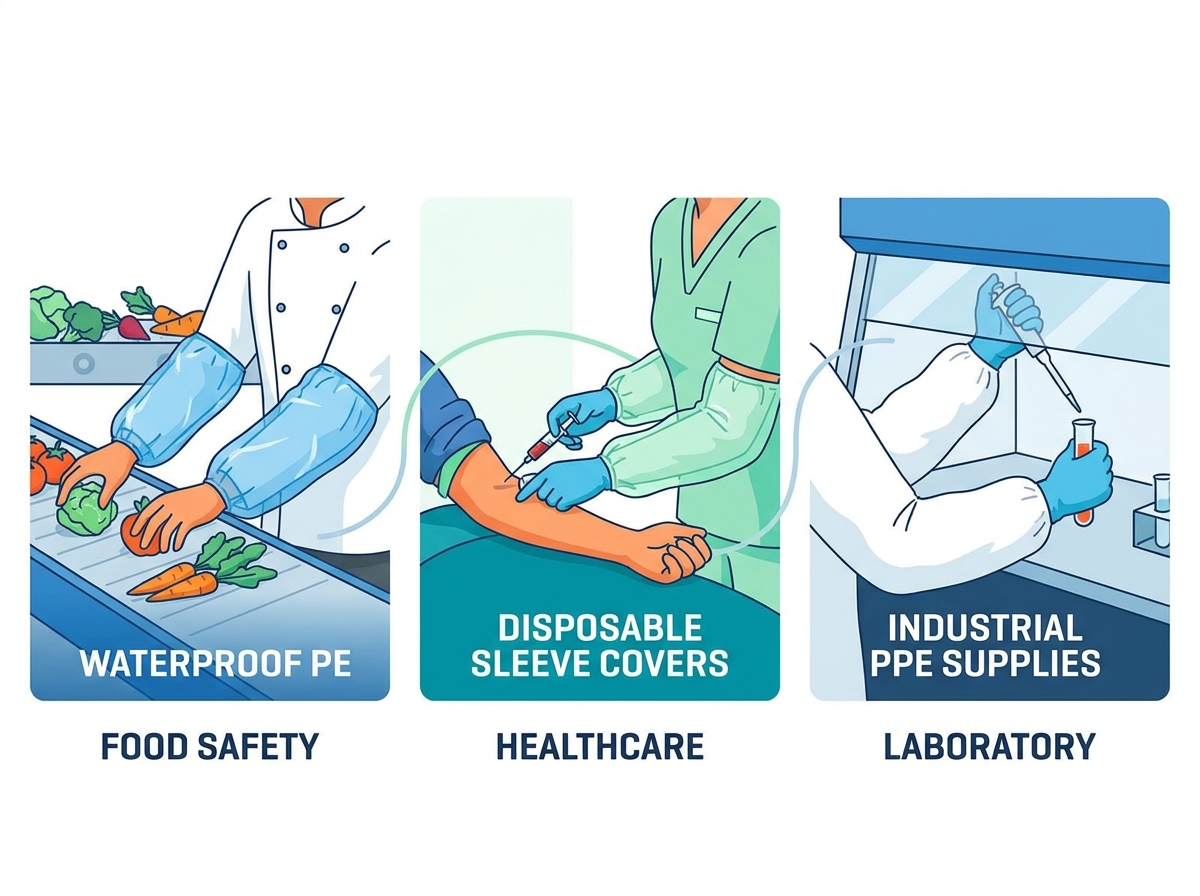
Effective Disposable Sleeve Covers create a strict, impermeable barrier. They drastically reduce contact between workers' personal clothing fibers and active production areas. This separation prevents foreign object contamination in the final consumer product. FDA requirements dictate strict standards for all food-contact materials. Facilities must ensure their protective gear contains no toxic plasticizers or restricted chemical additives. Color-coding remains a vital safety protocol in these environments. High-visibility blue sleeves allow rapid visual detection if a piece tears and falls into the food processing line. This visual contrast against natural food colors prevents catastrophic product recalls. You will rarely see white plastics on a modern poultry or beef processing line for this exact reason. Sanitation shifts require entirely different gear than production shifts. Washdown crews need heavy-duty PVC or thick CPE to withstand high-pressure hot water and aggressive foaming sanitizers.
Complete protection against blood-borne pathogens is a mandatory requirement. Infectious fluids require robust, tested barriers to protect healthcare workers from exposure. ASTM standards for synthetic blood penetration and viral penetration guide these strict requirements. Sleeve covers function as a critical adjunct to standard medical gowns. They provide necessary reinforcement during high-fluid surgical procedures. Complex wound care and specific infectious patient care scenarios demand this extra layer of localized protection. Healthcare facilities must verify that their chosen sleeves meet specific medical-grade barrier classifications before deployment. A standard food-grade sleeve will not pass ASTM F1671 testing for viral penetration. You must source specifically rated clinical barriers to ensure staff safety during triage or operating room procedures.
Safety managers must match sleeve cover materials to specific chemical hazards accurately. Organic solvents require different polymer resistances than highly concentrated inorganic acids. ISO cleanroom classifications demand strict adherence to particulate limits. Sterile, low-shedding sleeves protect highly sensitive medical and diagnostic equipment. They block human skin oils, dead skin cells, and micro-particulates effectively. Any breach in this barrier can compromise expensive silicon wafer production or sensitive biological assays. Cleanroom sleeves undergo specialized sterilization processes and require specific double-bagging packaging to maintain their integrity before entering the controlled environment. Facilities manufacturing sensitive electronics also require anti-static treatments on their sleeves to prevent electrostatic discharge from damaging microscopic components.
Proper sizing directly impacts worker safety and task efficiency. Elastic bands at the wrist and bicep must ensure a secure fit. Knitted elastics often provide better comfort than standard raw rubber elastics. A proper fit prevents restricted blood flow and painful skin chafing during repetitive motions. Sleeves that are too tight cause rapid muscle fatigue and localized pain. Sleeves that are too loose snag on moving machinery and compromise the protective seal. Providing multiple size options ensures all workers maintain a secure, comfortable barrier throughout their shift. Standard 18-inch sleeves fit most workers, but facilities with diverse workforces should stock 20-inch and 22-inch variants to accommodate longer arm spans and thicker primary garments.
Cheap, easily torn sleeves increase daily usage rates exponentially. They cause constant operational downtime as workers stop to replace failed gear. Investing in higher-quality materials reduces this replacement frequency significantly. You must evaluate the operational disruption caused by mid-task sleeve failures. A thicker, more resilient sleeve maintains the protective barrier longer, ensuring continuous workflow and better overall safety compliance. Evaluating the physical demands of the task helps determine the necessary thickness and tear resistance required to survive a full shift.
Track the number of sleeves consumed per shift over a two-week period to establish a baseline.
Record the specific reasons for replacement, such as snags, chemical degradation, or elastic failure.
Calculate the time lost during each replacement cycle, including walking to the dispenser and doffing contaminated gear.
Compare the operational cost of this downtime against the price premium of upgrading to a thicker, more durable sleeve.
Securing a consistent inventory of critical industrial PPE supplies requires strategic, long-term planning. Thorough vendor vetting ensures reliable delivery schedules during global supply disruptions. Bulk purchasing logistics require careful warehouse management and inventory rotation. Shelf-life considerations remain important, as certain plastics degrade or become brittle when stored in extreme temperatures for extended periods. Maintaining continuous operational readiness demands a diversified and resilient supply chain approach. Safety managers must establish minimum stock levels to prevent dangerous operational shortages. Implementing vendor-managed inventory systems helps automate reordering and ensures you never run out of critical protective barriers during peak production months.
Workers frequently remove or modify uncomfortable sleeve covers. Heat stress and restricted movement drive this dangerous non-compliance. Mitigate this behavioral risk by involving end-users directly in the evaluation process. Prioritize breathable materials where the safety profile permits. Conduct extensive wear trials to ensure the selected sleeves do not impede fine motor skills or cause excessive discomfort during long shifts. Educating workers on the specific hazards they face increases voluntary compliance and reinforces the importance of maintaining the protective barrier. A strong safety culture relies on open feedback. If a specific brand of sleeve constantly slides down a worker's arm, you must source an alternative with better bicep elasticity rather than punishing the worker for adjusting it.
Severe cross-contamination occurs if workers fail to dispose of sleeves when moving between distinct facility zones. You must emphasize strict donning and doffing protocols. Treat these items as strictly temporary barriers. Dispose of them immediately after use before crossing into clean areas. Visual reminders and strict supervisory enforcement help maintain these critical zoning boundaries. Training programs must demonstrate how to remove contaminated sleeves without touching the exterior surface to prevent self-contamination. Implementing a color-coded system by zone drastically reduces these errors. For example, mandate red sleeves for raw meat handling, blue for cooked meat processing, and white for final packaging. This visual system allows supervisors to spot zoning violations instantly from across the floor.
Prolonged exposure to latex elastics or trapped moisture often causes severe contact dermatitis. Sweat accumulation inside non-breathable plastics exacerbates skin breakdown. Recommend latex-free elastic alternatives for all protective gear. Implement strict wear-time protocols to allow the skin to breathe periodically. Providing lightweight cotton under-sleeves can absorb sweat and protect sensitive skin from direct plastic contact. Monitoring workers for early signs of skin irritation prevents chronic occupational health issues. Supplying approved, unscented barrier creams in the locker rooms also helps workers protect their skin barrier before donning non-breathable plastics for a full shift.
Facilities must outline compliant disposal protocols for all contaminated sleeves. You must separate biohazard materials and chemically tainted plastics from standard municipal waste. Improper disposal leads to severe regulatory fines and environmental damage. Acknowledge the environmental trade-offs of relying heavily on single-use plastics in industrial settings. Explore specialized recycling programs specifically designed for uncontaminated industrial plastics where local infrastructure supports it. Implementing volume reduction strategies, like industrial compactors, helps manage the physical waste footprint effectively and reduces the frequency of waste hauling services.
Request comprehensive material data safety sheets for all prospective protective garments before making procurement decisions.
Conduct on-site wear trials with a diverse sample group across different operational shifts to validate comfort and durability.
Audit your current glove-to-sleeve interface immediately to identify existing vulnerability gaps in your contamination control protocols.
Establish clear, visually marked zoning protocols for donning and doffing protective equipment to prevent cross-facility contamination.
A: Polyethylene (PE) offers a basic, smooth waterproof barrier suitable for light tasks. Chlorinated Polyethylene (CPE) undergoes a chemical process that increases its thickness, tensile strength, and flexibility. CPE features a textured surface for better grip and provides superior durability in demanding environments.
A: They provide excellent resistance to water, light oils, and mild alkalis. However, they are not suitable for handling aggressive industrial chemicals, concentrated acids, or volatile organic solvents. Always consult chemical compatibility charts before use in hazardous environments.
A: Measure the circumference of the worker's bicep and wrist over their primary garments. The elastic should fit snugly without restricting blood flow or leaving deep indentations on the skin. Most standard sleeves are 16 to 18 inches long to cover the entire forearm.
A: Yes, provided they are manufactured from low-linting materials like microporous films or specialized non-wovens. They must be sterilized and individually packaged to meet specific ISO particulate shedding standards before entering the controlled cleanroom environment.
A: The FDA requires that all materials contacting food must be free of toxic plasticizers, heavy metals, and harmful chemical additives. They must comply with strict regulations for safe food contact and are often color-coded blue for easy visual identification.
A: Workers must change them immediately if they tear, puncture, or become heavily soiled. They should also be replaced every time a worker moves between different contamination zones or returns from a scheduled break to prevent cross-contamination.